What a Stripe–PayPal Combination Could Mean for the Architecture of Digital Commerce
Why the convergence of merchant infrastructure, consumer identity, and AI commerce may matter as much as the transaction itself
Executive Summary
The reported effort by Stripe and Advent International to acquire PayPal is being viewed primarily as a major fintech transaction.
That interpretation may be incomplete.
If completed, the proposed combination would bring together some of the most important layers of modern digital commerce: merchant infrastructure, consumer wallets, payment execution, digital identity, commercial data, and increasingly, artificial intelligence.
The transaction would therefore represent more than consolidation within payments.
It could be another signal that the architecture of digital commerce is entering a new phase.
In Rapid Analysis #1, What XMoney Really Means, DigitalGift Research examined how companies including X, Visa, Mastercard, Stripe, PayPal, and Shopify are independently moving toward a common architectural direction: commerce organized around persistent, identity-linked relationships rather than isolated transactions.
A potential Stripe–PayPal combination introduces a new development.
The convergence may no longer be occurring only through product development and infrastructure investment.
It may increasingly be occurring through strategic consolidation.
The proposed transaction would combine capabilities that historically developed as separate layers:
Merchant commerce infrastructure
- Payment processing
- Consumer wallets
- Identity
- Trusted relationships
- Commercial history
- Financial services
- AI-enabled commerce
The significance lies not in the simple aggregation of those capabilities.
It lies in the architectural questions that arise when they begin operating within the same strategic system.
From Architectural Convergence to Strategic Consolidation
Across the digital commerce landscape, major companies have been independently building toward increasingly similar architectural objectives.
X is bringing identity, messaging, value, and commerce into a persistent environment.
Visa is developing infrastructure for identity-aware and authorized AI-enabled commerce.
Mastercard is building systems designed to enable trusted commercial activity initiated by AI agents.
Stripe is expanding its role in merchant infrastructure and increasingly positioning itself for AI-driven and agentic commerce.
PayPal operates one of the world’s most established consumer wallet and payment ecosystems.
Shopify is extending identity and commercial relationships beyond individual storefronts and transactions.
Different companies. Different products. Different entry points.
Yet the direction of travel is increasingly similar.
Digital commerce is becoming less organized around the isolated transaction and more organized around the persistent commercial relationship.
The proposed Stripe–PayPal transaction is significant because it could combine several of those layers within a single strategic system.
The convergence is easier to see when the major platforms are viewed not by their current products, but by the architectural direction each is pursuing.
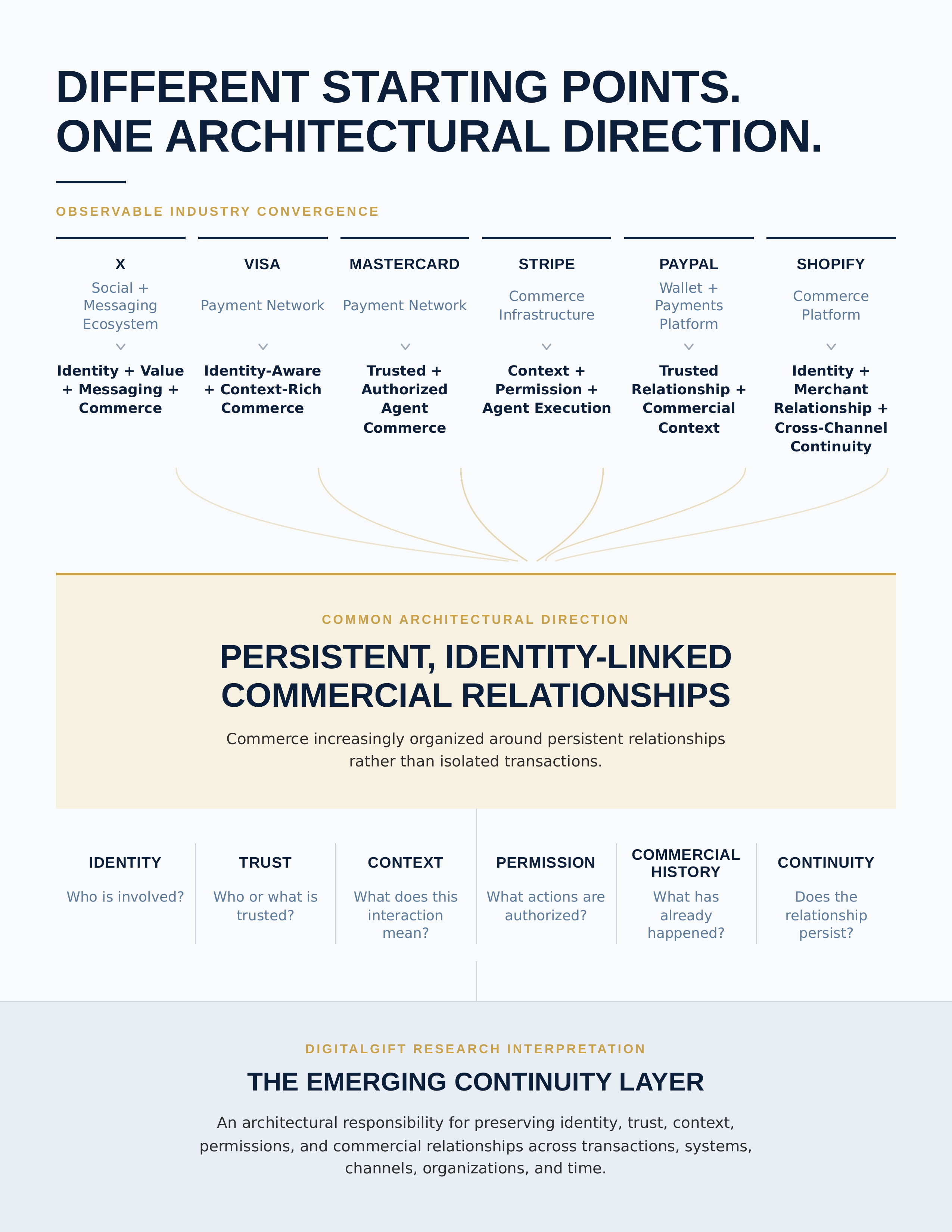
The chart illustrates an analytical framework for comparing the converging architectural direction of major commerce, payments and fintech platforms. It does not suggest that the companies have identical strategies, products or technical architectures.
What the Combination Would Bring Together
Historically, the major layers of digital commerce have often developed independently.
Payment processors focused on execution. Wallets focused on storing credentials and enabling consumer access. Commerce platforms focused on merchants and transactions. Social platforms focused on identity, interaction, and engagement. Financial networks focused on authorization, routing, and trust.
Artificial intelligence is now introducing another layer: systems capable of participating in commerce autonomously.
The proposed Stripe–PayPal transaction would bring several previously distinct layers into closer alignment.
Stripe
Stripe has become a foundational layer of merchant and developer infrastructure.
Its role is centered on enabling businesses to build, operate, and scale commercial activity across the internet.
That position gives Stripe a powerful relationship with the execution side of commerce.
Stripe increasingly sits where businesses create commercial experiences, accept payment, manage subscriptions, and connect digital services.
Its expanding interest in AI further extends that position toward a future in which commerce may increasingly be initiated, managed, and executed through intelligent systems.
PayPal
PayPal represents a different starting point.
Its historical strength is closer to the consumer.
The wallet, payment identity, account relationship, and accumulated history of commercial activity represent a different layer of the architecture.
PayPal and its broader ecosystem sit at the intersection of:
- Consumer identity
- Stored value and payment credentials
- Trusted commercial relationships
- Purchase history
- Merchant relationships
- Financial services
Stripe and PayPal therefore approach digital commerce from opposite sides of the transaction.
Stripe begins largely with the merchant and infrastructure environment.
PayPal begins largely with the consumer and wallet relationship.
The strategic significance of a combination could lie in what happens between those two positions.
The Architecture Between the Merchant and the Consumer
Commerce does not begin and end when payment authorization occurs.
A transaction is one moment within a much longer relationship.
Before a transaction occurs, there may already be:
- Identity
- Intent
- Trust
- Preferences
- Permissions
- History
- Communication
- Offers
- Prior interactions
After the transaction, the relationship may continue through:
- Receipts
- Rewards
- Customer service
- Messaging
- Additional purchases
- Stored preferences
- Subscriptions
- Financial activity
Traditional payments infrastructure is extraordinarily effective at moving value.
But the movement of value is not the same thing as preserving the commercial relationship surrounding it.
As digital commerce becomes more distributed, this distinction becomes increasingly important.
A customer may interact through:
- A merchant application
- A wallet
- A marketplace
- A social platform
- A messaging environment
- An AI agent
- A digital assistant
- A connected device
The transaction may occur in one environment. The relationship may extend across many.
The architectural challenge is therefore not simply:
Why Artificial Intelligence Changes the Equation
Artificial intelligence increases the importance of commercial continuity.
Traditional digital commerce generally assumed that the consumer was directly participating in each transaction.
The consumer browsed. The consumer selected. The consumer authorized. The consumer completed the transaction.
AI changes that sequence.
An intelligent system may increasingly participate on behalf of the consumer.
It may:
- Search
- Compare
- Recommend
- Negotiate
- Initiate
- Purchase
- Manage subscriptions
- Reorder products
- Communicate with merchants
That requires more than access to payment credentials.
An AI system must increasingly understand the context in which it is acting.
Who is the customer? What authority has been granted? What preferences apply? What commitments already exist? What merchant relationships should be preserved? What has already occurred? What information should persist across the next interaction?
The future of AI commerce therefore creates a greater need for persistent commercial context.
Payment infrastructure alone cannot answer every one of those questions.
The Emerging Battle for the Commercial Relationship
For years, competition in fintech has often focused on who controls the transaction.
That question remains important.
But a more significant competition may be emerging:
M&A May Be Following the Architecture
The proposed Stripe–PayPal transaction introduces a broader question for the fintech industry.
If companies are independently discovering that the future of commerce requires multiple connected architectural layers, will they increasingly seek to acquire those layers rather than build each one independently?
That would represent a shift from product expansion toward architectural assembly.
Under this model, strategic M&A becomes a way of acquiring missing layers of the commercial system.
A company with merchant infrastructure may seek stronger consumer relationships. A consumer platform may seek greater payment execution capabilities. A payment network may seek AI authorization infrastructure. A commerce platform may seek identity portability. An AI company may seek transaction capabilities.
The strategic question becomes:
Different Assets. One Commercial System.
The architecture of commerce has historically been fragmented.
Different organizations control different elements.
One controls the payment rail. Another controls the wallet. Another controls the merchant relationship. Another controls the consumer identity. Another controls the AI interface. Another controls the marketplace.
This fragmentation has worked because each transaction could generally be treated as an event.
The transaction started. The transaction was authorized. Value moved. The transaction ended.
But commerce is becoming increasingly continuous.
The same commercial relationship may move across:
- Applications
- Platforms
- Devices
- Agents
- Wallets
- Marketplaces
- Networks
- Physical and digital environments
The infrastructure supporting that relationship must increasingly maintain continuity across those changes.
That creates a different architectural requirement.
The future commercial system may not be defined by a single dominant payment rail.
It may instead be defined by the platforms capable of preserving the commercial relationship while value moves across multiple rails.
The Emerging Continuity Layer
DigitalGift Research describes this architectural responsibility as the Continuity Layer.
The Continuity Layer is not another payment rail. It is not simply a wallet. It is not a customer database. It is not an identity credential.
It is the architectural responsibility for preserving commercial continuity across systems, channels, organizations, and time.
It connects dimensions including:
- Identity
- Trust
- Context
- Permissions
- Commercial history
- Relationships
The purpose is to allow commerce to retain meaning as it moves.
This is particularly important in an environment where the next commercial interaction may not occur through the same application, platform, device, or even the same type of participant.
The consumer may be replaced by an AI agent. The merchant interaction may occur inside another platform. The payment method may change. The relationship must still persist.
Why the Proposed Transaction Matters
The significance of a potential Stripe–PayPal combination should not be reduced to the question of whether the combined organization would become larger or more competitive.
The more important question may be:
Looking Ahead
The proposed Stripe–PayPal transaction remains a transaction, not an inevitability.
Its strategic implications depend on whether it is completed, how it is structured, and how the resulting organizations are ultimately integrated.
But the transaction is significant even before those questions are resolved.
It reveals the strategic importance of the layers involved.
A major fintech company and a major private equity firm do not pursue a transaction of this scale simply to own a larger payment processor.
The strategic value lies in the capabilities, relationships, infrastructure, and future optionality that may be assembled.
For DigitalGift Research, the development reinforces a broader observation.
The architecture of digital commerce is changing.
First, the evidence appeared in product announcements.
AI agents. Identity-aware commerce. Persistent wallets. Trusted digital relationships. Context-rich transactions.
Now, strategic M&A may be beginning to reflect the same direction.
The convergence is becoming visible not only in what companies are building.
It may increasingly be visible in what they seek to own.
KEY TAKEAWAY
The proposed Stripe–PayPal transaction may represent more than fintech consolidation. It may signal the beginning of a new phase in which major platforms seek to assemble complementary layers of the emerging architecture of digital commerce.
THE VISION
The next phase of fintech may not be defined by who owns the fastest payment rail. It may be defined by who can assemble—and preserve—the most complete commercial relationship around the movement of value.
Recommended Reading
Commercial Continuity
Why Enterprise Architecture Must Represent Commerce as Continuously as Customers Experience It
Read the white paperWhat XMoney Really Means
Why the Launch of XMoney Signals the Next Phase of Digital Commerce Architecture
Commerce Has Always Been Continuous
Why Enterprise Architecture Must Evolve Beyond Transactions
The Continuity Layer
The Missing Architectural Layer in Modern Enterprise Commerce
Identity-Linked Commerce
The Next Evolution of Enterprise Architecture