Commerce Has Always Been Continuous
Why Enterprise Architecture Must Evolve Beyond Transactions
Customers never experience transactions. They experience continuity.
Customers never experience transactions. They experience continuity. Enterprise architecture has become exceptionally good at representing the former while largely reconstructing the latter.
Executive Summary
Enterprise architecture has transformed commerce.
Few technological achievements have influenced the global economy more profoundly than the ability to process, coordinate, reconcile, and govern billions of commercial transactions with extraordinary precision. Modern enterprises execute orders across continents in milliseconds. Payments settle almost instantly. Supply chains synchronize production among thousands of independent organizations. Artificial intelligence analyzes commercial activity at a scale unimaginable only a generation ago.
These accomplishments represent one of the great successes of enterprise computing.
Yet beneath that success lies an architectural assumption that has remained largely unquestioned.
Enterprise architecture primarily represents commerce through events.
Customers do not experience commerce that way.
Customers experience relationships.
A customer never believes they have begun a new commercial relationship because a retailer replaced its commerce platform. A patient does not perceive separate healthcare experiences because multiple providers participate in treatment. A traveler does not divide a journey into independent interactions with airlines, hotels, payment providers, rideshare companies, and reservation systems. From the customer’s perspective, every interaction belongs to one continuous relationship.
Commerce has always worked this way.
Long before enterprise software existed, merchants accumulated trust through repeated exchanges. Relationships matured because every interaction influenced those that followed. Transactions made those relationships economically visible, but they never created them.
Modern enterprise architecture changed how commerce is represented—not how commerce is experienced.
That distinction has become increasingly important as commerce expands across ecosystems of organizations, software platforms, intelligent systems, payment networks, and digital identities. Operational responsibility is distributed among many participants. Experiential continuity remains singular.
Organizations now spend enormous effort reconstructing the continuity that customers naturally assume already exists.
Artificial intelligence assembles context before making recommendations.
Employees review years of account history before meetings.
Customer success teams consolidate information from dozens of applications.
Integration platforms synchronize records across countless systems.
These investments improve coordination.
They also reveal something deeper.
Increasingly, organizations are rebuilding continuity because enterprise architecture has never explicitly represented it.
This essay introduces a simple but consequential observation.
CENTRAL THESIS
Commerce has always been continuous. What has changed is the architecture through which commerce is represented. That observation forms the foundation of the Commercial Continuity framework.
Commerce has always been continuous.
What has changed is the architecture through which commerce is represented.
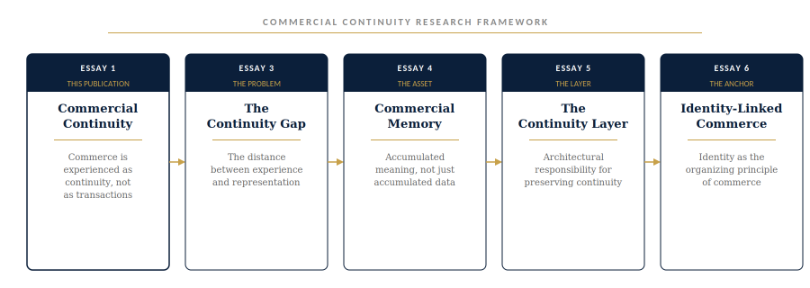
That observation forms the foundation of the broader Commercial Continuity framework introduced by DigitalGift Research. The framework proposes that continuity deserves explicit architectural representation alongside transactions, enabling organizations to preserve relationships rather than continually reconstruct them. The complete framework—including the concepts of the Continuity Gap, Commercial Memory, the Continuity Layer, and Identity-Linked Commerce—is developed in the companion white paper Commercial Continuity: Why Enterprise Architecture Must Represent Commerce as Continuously as Customers Experience It.
The complete framework—including the Continuity Gap, Commercial Memory, the Continuity Layer, and Identity-Linked Commerce—is developed in the companion white paper, Commercial Continuity: Why Enterprise Architecture Must Represent Commerce as Continuously as Customers Experience It, published by DigitalGift Research.
Commerce Has Never Been About Individual Transactions
If enterprise architects were asked to identify the fundamental unit of commerce, many would understandably answer:
An order.
A payment.
An invoice.
A shipment.
A contract.
Those answers are operationally correct.
They are not experientially complete.
No customer has ever described a twenty-year relationship with a bank as a collection of debit card authorizations. No manufacturer measures decades of supplier collaboration as an archive of purchase orders. No patient reflects on years of healthcare by remembering appointment identifiers or insurance claims.
People remember relationships.
The operational record documents what occurred.
The relationship preserves what those events became.
That distinction has existed throughout the history of commerce.
Long before digital systems, merchants extended credit because they remembered previous commitments. Craftsmen reserved their finest work for returning customers because confidence had accumulated over years of successful exchanges. Communities traded through reputations developed across generations rather than isolated economic events.
Commerce advanced because every transaction left something behind.
Confidence increased.
Expectations evolved.
Understanding deepened.
Future decisions became easier because previous interactions remained meaningful.
Commerce advanced because every transaction left something behind. Confidence increased. Expectations evolved. Understanding deepened.
The transaction was never the destination.
It was one contribution to an evolving commercial relationship.
Industrialization changed the scale of commerce but not its underlying nature.
Organizations developed contracts, accounting systems, customer records, warranties, brands, and institutional processes that allowed continuity to survive beyond the memory of individual employees. As enterprises expanded, institutions gradually inherited responsibilities that had once belonged almost exclusively to people.
The objective, however, remained unchanged.
Relationships continued.
Only the mechanisms preserving them evolved.
The digital era introduced another transformation.
Enterprise software achieved something extraordinary.
It enabled organizations to represent commercial activity with unprecedented accuracy. Orders could be processed globally. Financial events became auditable almost instantly. Inventory synchronized across continents. Customer interactions could be recorded in ways impossible only decades earlier.
Modern enterprise architecture became extraordinarily successful because it represented commercial events with exceptional precision.
Its influence on global commerce cannot be overstated.
Yet success often makes assumptions invisible.
As enterprise systems became increasingly effective at representing events, the event itself gradually became the primary architectural object.
Commerce became modeled as transactions because transactions are observable, measurable, governable, and operationally significant.
Relationships behave differently.
They develop gradually.
They have no obvious beginning.
They rarely possess a clearly defined ending.
They accumulate through hundreds—sometimes thousands—of interactions whose significance becomes visible only when viewed together rather than individually.
A single purchase rarely explains customer loyalty.
A single support interaction seldom defines trust.
A single payment never explains why two organizations continue choosing one another over decades.
The meaning exists across the relationship rather than inside any individual event.
That observation has profound implications for enterprise architecture.
Events Are Not Relationships
This distinction appears subtle until viewed from the perspective of the customer.
An enterprise records a payment because the payment represents a completed financial event. The customer remembers whether the organization solved a problem, honored a promise, or reinforced confidence. Those two perspectives often overlap, but they are not identical. One captures what happened. The other captures what changed.
Every meaningful commercial interaction alters the relationship in some way.
Sometimes confidence grows because an organization exceeds expectations. Sometimes trust declines because a commitment is broken. Occasionally a single interaction transforms the trajectory of an entire relationship. More often, however, continuity evolves gradually through hundreds of small interactions whose individual importance appears insignificant but whose cumulative effect becomes decisive.
Commerce has always behaved this way.
Relationships accumulate.
Transactions document.
Those functions are complementary rather than interchangeable.
Enterprise architecture has traditionally excelled at representing documentation. Systems faithfully record orders, invoices, authorizations, shipments, subscriptions, support cases, contracts, returns, and financial settlements. Each event becomes part of an auditable operational history that allows organizations to execute business with remarkable efficiency.
Yet the relationship itself rarely exists as a first-class architectural object.
Instead, organizations infer relationships by assembling collections of historical transactions after the fact.
This distinction explains why enterprises continue investing enormous resources in technologies designed to “create a 360-degree customer view.” Customer Data Platforms aggregate behavioral data from dozens of operational systems. CRM platforms consolidate records across business units. Identity platforms reconcile users across applications. Data warehouses centralize information from operational databases. Artificial intelligence reconstructs context before producing recommendations or assisting employees.
These investments are valuable because they reduce fragmentation. They also expose a deeper architectural reality.
Organizations repeatedly rebuild continuity because continuity was never explicitly represented.
The challenge is not that enterprise systems fail to remember. On the contrary, modern enterprises retain more information than at any point in history. The challenge is that information remains distributed across representations of individual events. Understanding the relationship requires continuously reconstructing meaning from those events rather than preserving that meaning as commerce unfolds.
This reconstruction has become one of the defining characteristics of modern digital enterprises.
Consider a customer contacting a financial institution after maintaining an account for fifteen years. The representative typically reviews account history, support interactions, previous disputes, product usage, payment patterns, and service notes before responding. None of this information is missing. It simply exists in separate representations that must be interpreted together before the organization can understand the relationship the customer has experienced continuously for years.
The same pattern appears across nearly every industry.
Healthcare providers assemble patient histories from numerous clinical systems before making treatment decisions. Manufacturers consolidate supplier performance from procurement, logistics, quality assurance, and finance before evaluating strategic partnerships. Retailers aggregate purchase history, loyalty activity, digital engagement, and customer service records before determining how best to serve an individual customer.
The Architectural Assumption We Rarely Question
For decades, enterprise architecture has been organized around the assumption that commercial events provide the most appropriate foundation for representing business activity.
That assumption has been extraordinarily successful.
Transactions are discrete. They possess clearly defined boundaries. They support governance, compliance, auditing, accounting, reporting, and operational execution. Their precision allows enterprises to coordinate billions of commercial activities every day with levels of reliability that would once have seemed impossible.
None of this should be diminished.
Commercial Continuity does not argue that transaction-oriented architecture is incorrect. It argues that it is incomplete.
The distinction is important.
Every major advance in enterprise architecture has expanded rather than replaced what came before. Relational databases did not eliminate accounting systems. Enterprise Resource Planning did not replace financial controls. Customer Relationship Management did not eliminate order management. Cloud computing did not invalidate enterprise applications.
Each innovation added a new representational capability while preserving the value of existing ones.
Commercial Continuity proposes a similar evolution.
Transactions remain indispensable because organizations must continue governing operational events with precision. What changes is the recognition that those events exist within a larger continuum of commercial relationships that also deserve explicit architectural representation.
Viewed through this lens, many contemporary technology initiatives begin to look different.
Identity becomes more than authentication.
Customer history becomes more than historical reporting.
Artificial intelligence becomes more than predictive analytics.
Integration becomes more than data synchronization.
Each becomes part of a broader effort to preserve commercial continuity across increasingly distributed digital ecosystems.
This shift is especially significant because commerce itself has changed. Organizations no longer operate as isolated enterprises with clearly defined boundaries. Value is created across networks of payment providers, software platforms, cloud services, marketplaces, logistics partners, communication systems, AI agents, and digital identities. Operational
execution is distributed among many participants, yet the customer’s expectation remains unchanged.
They expect one continuous relationship.
The greater the number of participating systems, the more important continuity becomes.
Ironically, the success of distributed architecture has increased the importance of preserving what distribution naturally fragments.
That realization marks the beginning of a different way of thinking about enterprise architecture—not as a collection of systems processing isolated events, but as an architecture capable of representing commerce with the same continuity customers have always experienced.
From Observation to Architecture
Recognizing that commerce is continuous is not, by itself, a new discovery.
Every experienced executive understands intuitively that organizations succeed by building relationships rather than simply processing transactions. Boards routinely discuss customer lifetime value, brand trust, retention, reputation, loyalty, and long-term partnerships. None of these concepts describe isolated commercial events. Each describes continuity developing over time.
What has remained largely absent is an architectural framework capable of representing that continuity directly.
Instead, continuity is typically treated as an emergent property—something inferred from data rather than modeled within it.
This distinction matters because representation shapes capability.
Context is rarely created. It is recovered. The customer never lost it. Only the enterprise did.
When enterprise architecture explicitly represents inventory, organizations become better at managing inventory. When architecture represents financial assets, financial governance improves dramatically. When customer identities become explicit architectural objects, authentication, authorization, and personalization become significantly more sophisticated.
Architecture influences organizational capability because representation determines what systems can preserve, govern, reason about, and extend.
Commercial relationships deserve the same evolution.
If continuity remains something reconstructed after transactions occur, organizations will continue investing enormous effort assembling context before meaningful decisions can be
made. Every recommendation engine, every customer service interaction, every AI assistant, every account review, and every strategic analysis begins by rebuilding the continuity that customers have experienced naturally all along.
The pattern is so familiar that it often escapes notice.
Organizations frequently describe this activity as creating “customer context.”
The phrase itself is revealing.
Context is rarely created.
Commercial Continuity
Commercial Continuity begins with a simple proposition.
Commerce should be represented as continuously as customers experience it.
That statement is intentionally straightforward because its implications are anything but.
Commercial Continuity does not replace transaction-oriented systems. Orders must still be processed. Payments must still settle. Contracts must still be governed. Compliance obligations remain essential. Financial controls remain indispensable.
Operational precision continues to matter.
Commercial Continuity asks a different question.
What architectural object preserves the evolving commercial relationship that those operational events collectively create?
For decades, the answer has effectively been:
“There isn’t one.”
Instead, enterprises have relied on historical records, application integrations, reporting platforms, identity systems, analytics engines, and increasingly artificial intelligence to reconstruct continuity whenever it becomes necessary.
Commercial Continuity proposes that the relationship itself deserves explicit representation.
The relationship becomes more than a report.
More than a customer record.
More than a CRM profile.
More than a transaction history.
It becomes a continuously evolving architectural asset whose state reflects the cumulative meaning of every interaction rather than merely the archive of those interactions.
This distinction mirrors earlier transformations throughout enterprise computing.
Accounting systems evolved beyond handwritten ledgers because financial state became an explicit representation.
Supply chains evolved beyond disconnected inventories because operational state became explicitly modeled.
Identity management transformed authentication because digital identity became a persistent architectural object rather than a collection of usernames distributed across applications.
Commercial Continuity represents the same type of progression.
The relationship itself becomes persistent.
Not reconstructed.
Not inferred.
Maintained.
DEFINITION
Commercial Continuity: The architectural principle that commerce should be represented as continuously as customers experience it. Commercial Continuity does not replace transaction-oriented architecture. It extends it by proposing that the evolving commercial relationship deserves explicit architectural representation alongside operational events.
Why This Matters Now
For much of modern computing, reconstructing continuity was acceptable.
Organizations owned most of their technology.
Customer interactions occurred through relatively few channels.
Data volumes remained manageable.
Operational ecosystems were comparatively simple.
That environment no longer exists.
Today’s commercial experience spans mobile applications, web platforms, payment providers, marketplaces, logistics partners, cloud services, AI assistants, customer communities, connected devices, digital wallets, subscription platforms, healthcare systems, financial institutions, and increasingly autonomous software agents.
Each participant contributes to the customer’s experience.
Organizations often describe AI as requiring better data. More accurately, AI requires better continuity.
None owns the relationship in its entirety.
This creates a fundamental architectural challenge.
Operational execution becomes increasingly distributed while experiential continuity remains singular.
The customer still expects one relationship.
Not twenty.
As artificial intelligence becomes embedded throughout enterprise operations, this expectation becomes even more significant.
Every AI system begins by gathering context.
Every recommendation engine reconstructs prior interactions.
Every intelligent assistant assembles historical information before producing useful guidance.
Artificial intelligence has made continuity more valuable precisely because intelligent systems depend upon understanding continuity before they can reason effectively.
Organizations often describe AI as requiring better data.
A Different Representation of Commerce
Commercial Continuity does not suggest that transactions become less important.
They become more meaningful.
Every order, payment, message, fulfillment, recommendation, support interaction, contract amendment, renewal, or service event contributes to something larger than itself.
Each interaction changes the commercial relationship.
Architecture should preserve that change.
When continuity becomes an explicit architectural concern, familiar enterprise capabilities begin to evolve naturally.
Customer history becomes living commercial memory rather than archived operational data.
Identity becomes the persistent anchor connecting relationships across organizations and technologies.
Artificial intelligence reasons from accumulated continuity instead of reconstructed fragments.
Digital ecosystems coordinate around persistent commercial relationships rather than repeatedly exchanging disconnected representations of isolated events.
The result is not a different kind of commerce.
It is a different way of representing the commerce that has always existed.
From Commercial Continuity to Commercial Memory
Every significant shift in enterprise architecture has followed the same pattern.
First, practitioners recognize that reality is more complex than existing models describe. Then new architectural abstractions emerge that allow systems to represent that reality more faithfully. Over time those abstractions become so fundamental that organizations can scarcely imagine building enterprise systems without them.
Relational databases changed how organizations represented information because relationships between data became first-class architectural objects rather than implicit connections scattered throughout applications.
Object-oriented programming transformed software because behavior and state could be represented together rather than independently.
Cloud computing changed infrastructure because computing resources became persistent architectural services rather than physical assets tied to individual machines.
Commercial Continuity represents a similar progression.
Its significance does not arise from introducing new business processes. Organizations already strive to preserve customer relationships, institutional trust, and commercial context. The significance lies in recognizing that these objectives deserve explicit architectural representation rather than perpetual reconstruction.
Once continuity becomes an architectural concern, another question naturally follows.
What exactly is being preserved?
The answer is not simply history.
History records events.
Continuity preserves meaning.
That distinction introduces one of the central concepts within the Commercial Continuity framework:
Commercial Memory
Commercial Memory is not an archive.
It is not a transaction log.
It is not a CRM record.
It is not a reporting database.
Commercial Memory is the persistent accumulation of commercial meaning created as relationships evolve.
Every interaction contributes to it.
Every commitment modifies it.
Every fulfilled promise strengthens it.
Every broken expectation weakens it.
Unlike operational history, Commercial Memory does not ask merely, What happened?
It asks,
What has this relationship become because it happened?
That difference fundamentally changes architectural thinking.
Two customers may possess identical purchase histories while maintaining entirely different commercial relationships.
Two suppliers may complete the same number of transactions while exhibiting dramatically different levels of strategic trust.
Two patients may undergo identical clinical procedures while experiencing completely different confidence in their providers.
Operational history appears identical.
Commercial Memory does not.
Because Commercial Memory represents accumulated meaning rather than accumulated events, it becomes significantly more valuable for future decision making.
Artificial intelligence can reason from it.
Organizations can govern it.
Partners can preserve it.
Customers can experience it consistently across ecosystems.
The enterprise no longer reconstructs continuity.
It inherits it.
DEFINITION
Commercial Memory:
The persistent accumulation of commercial meaning created as relationships evolve. Unlike transaction history, which records what happened, Commercial Memory preserves what the relationship has become because it happened.
Why Commercial Memory Matters
Most organizations already recognize that relationships possess value extending beyond individual transactions.
Customer Lifetime Value attempts to estimate it.
Brand equity attempts to measure it.
Net Promoter Scores attempt to approximate it.
Loyalty programs attempt to reinforce it.
Customer Success organizations attempt to preserve it.
Each initiative acknowledges the same reality.
Relationships become assets.
Yet enterprise systems rarely represent those assets directly.
Instead, organizations continuously estimate relationship quality by interpreting historical operational data.
Commercial Memory proposes something different.
Rather than repeatedly calculating the current state of a relationship from historical events, architecture maintains that evolving state continuously.
This mirrors how people naturally understand relationships.
No one reconstructs a friendship by reviewing every previous conversation.
No executive reevaluates a decades-long business partnership by rereading every contract before each meeting.
Meaning accumulates.
Memory persists.
Future interactions inherit that accumulated understanding.
Commerce has always worked the same way.
Enterprise architecture simply has not represented it explicitly.
The Continuity Layer
If Commercial Memory represents what relationships become over time, another architectural question emerges.
Where does that representation belong?
Traditional enterprise systems organize around operational domains.
Finance governs financial events.
ERP governs operational execution.
CRM governs customer engagement.
Identity systems govern authentication.
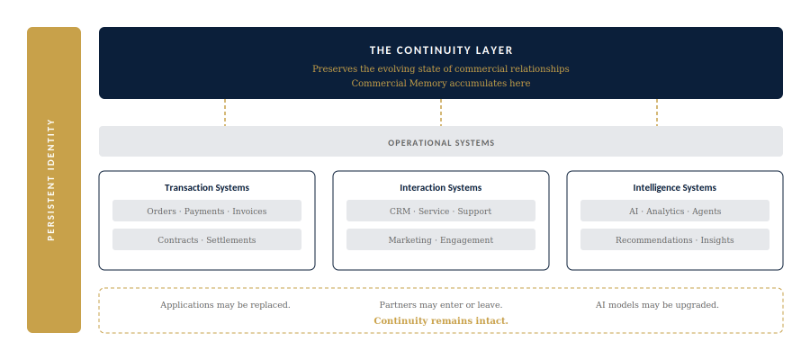
Supply chain systems govern logistics.
Each performs an essential role.
None governs commercial continuity itself.
This observation introduces the next architectural concept within the framework.
The Continuity Layer.
The Continuity Layer is not another application.
It is not another database.
It is not intended to replace ERP, CRM, payment infrastructure, identity providers, or operational platforms.
Instead, it represents an architectural layer responsible for preserving continuity across them.
Just as the internet introduced networking layers independent of individual applications, the Continuity Layer introduces a representational layer independent of individual operational systems.
Every participating system contributes to continuity.
None owns it exclusively.
The Continuity Layer maintains the evolving commercial relationship while allowing operational systems to continue performing their specialized responsibilities.
This distinction becomes increasingly important as enterprises embrace distributed architectures.
Modern organizations no longer operate within single technology stacks.
DEFINITION
The Continuity Layer
An architectural layer responsible for preserving the evolving state of commercial relationships independently of the individual operational systems participating in those relationships.
Identity as the Anchor of Continuity
Once continuity becomes persistent, identity assumes a profoundly different role.
Historically, digital identity has focused primarily on authentication and authorization.
Identity answers questions such as:
Who is this?
Can they access this resource?
What permissions should they possess?
Those functions remain essential.
Commercial Continuity extends identity beyond security.
Identity becomes the persistent anchor through which Commercial Memory accumulates and continuity evolves.
Relationships require persistence.
Persistence requires identity.
Without stable identity, continuity fragments.
Without continuity, Commercial Memory dissolves into disconnected operational records.
Identity therefore becomes more than a security mechanism.
It becomes the architectural foundation upon which commercial relationships persist across organizations, technologies, and time.
This insight leads naturally to the next stage of the Commercial Continuity framework.
Identity-Linked Commerce
Commerce has historically linked value to instruments.
Cash.
Cards.
Accounts.
Tokens.
Wallets.
Commercial Continuity proposes that the future increasingly links value to persistent identity rather than temporary instruments.
Payment methods will continue changing.
Wallets will evolve.
The question is no longer, Which payment method completed this transaction? The more important question becomes, How has this interaction changed the ongoing commercial relationship?
Technologies will mature.
Identity persists across those changes.
Identity therefore becomes the natural anchor for preserving Commercial Memory and maintaining continuity throughout increasingly distributed commercial ecosystems.
This concept—Identity-Linked Commerce—is explored extensively in the broader Commercial Continuity white paper because it represents the architectural evolution made possible once continuity itself becomes explicit.
The question is no longer,
DEFINITION
Identity-Linked Commerce
An architectural model in which persistent identity becomes the organizing principle through which commercial relationships, value, permissions, and continuity remain connected across distributed digital ecosystems.
Conclusion
Enterprise architecture has transformed commerce by representing transactions with extraordinary precision.
Its success has enabled global markets, digital ecosystems, intelligent automation, and operational efficiency at unprecedented scale.
Commercial Continuity does not challenge those achievements.
It builds upon them.
The next evolution of enterprise architecture is unlikely to be defined solely by processing transactions faster or integrating more systems.
It will be defined by how faithfully architecture represents the continuity customers have always experienced.
Commerce has never consisted of isolated events.
Transactions have always served relationships.
History has always contributed to memory.
Identity has always connected experience across time.
The opportunity before enterprise architects is not to reinvent commerce.
It is to represent commerce as it has always existed.
When continuity becomes explicit, Commercial Memory becomes preservable.
When Commercial Memory becomes preservable, identity becomes the persistent anchor of commercial relationships.
When identity anchors continuity, enterprises gain the ability to build systems that understand relationships not merely as collections of historical events, but as living commercial assets that evolve continuously over time.
THE VISION
When continuity becomes explicit, Commercial Memory becomes preservable. When identity anchors continuity, enterprises gain the ability to build systems that understand relationships as living commercial assets. That is Commercial Continuity.
That is the architectural vision underlying Commercial Continuity.
It is not a replacement for transaction-oriented architecture.
It is its next logical evolution.
For a comprehensive development of the complete Commercial Continuity framework, including detailed analysis of each architectural concept introduced in this essay, readers are encouraged to consult the DigitalGift Research white paper, Commercial Continuity.
Recommended Reading
Commercial Continuity
Why Enterprise Architecture Must Represent Commerce as Continuously as Customers Experience It
Read the white paper